If two houses in Pajaro Dunes sit on the same street, share the same builder, and list for close to the same price, do they cost the same to own? Not once you factor in the rock wall that protects both of them. One house may absorb seventeen times more of that cost than the other, and the difference has nothing to do with square footage, finishes, or even the HOA fee schedule most buyers ask for first.
The mechanism sits inside the Pajaro Dunes Geologic Hazard Abatement District, a special district most portals and even most listing sheets never mention by name. It is not the homeowners association. It bills separately, votes separately, and allocates cost by an entirely different logic: proximity to the hazard, not the price of the home.
Two Kinds of Bill, Two Kinds of District
Pajaro Dunes has multiple homeowners associations, one for each cluster of buildings, each with its own dues and its own CC&Rs. Those dues cover the things HOAs usually cover: gate staffing, common landscaping, insurance on shared structures, reserve funds for roofs and decks.
The Pajaro Dunes Geologic Hazard Abatement District is a different creature entirely. It exists to maintain and repair the community's coastal protections, primarily a rock revetment along the ocean side and a sheet pile wall near Pelican Point that holds back the Pajaro River and Watsonville Slough. When the district needs money for a major repair, it doesn't raise HOA dues. It runs a formal assessment election, complete with an engineer's report, a public hearing, and mailed ballots, and the resulting charge shows up on your property tax bill rather than your HOA statement.
That process matters because the engineer's report has to justify the assessment by proportional special benefit. Whoever benefits most from the protection has to pay the largest share of the cost. That single requirement is what produces the split buyers rarely see coming.
Distance from the water decides more than the view. In this district, it also decides who pays first to protect it.
The 85/10/5 Split
Under the district's 2024 engineer's report, which set the assessment structure still governing Zone 1 today, the cost allocated to the community's houses is not divided evenly by lot or by square footage. Front-row houses collectively absorb 85 percent of the house share. Second-row homes absorb 10 percent. Back-row homes absorb just 5 percent. Within the front row itself, the split tightens further: individual shares vary two to one depending on lot width, so a wide beachfront parcel can owe roughly double what a narrow one on the same row owes.
Condominium groups are billed differently again. Townhouse owners and Pelican Point condo owners each carry a fixed percentage of the total Zone 1 assessment, split equally among the members of their own association rather than by row.
Here is how the full Zone 1 pie breaks down, and how the house portion of it further divides by row:
| Property type | Share of total Zone 1 assessment |
|---|---|
| Front-row houses (collectively) | 85% of the house allocation |
| Second-row houses (collectively) | 10% of the house allocation |
| Back-row houses (collectively) | 5% of the house allocation |
| Townhouse owners | 11.85% of total Zone 1 costs, split equally among members |
| Pelican Point condominium owners | 10.18% of total Zone 1 costs, split equally among members |
| Pajaro Dunes Association (stairway access) | 2.53% of total Zone 1 costs |
Add the townhouse, Pelican Point, and stairway shares together and they account for about a quarter of the total. The remaining three-quarters falls to the houses, and within that, the front row carries the overwhelming majority of it. Pelican Point owners carry an added layer on top of their Zone 1 share: a separate Zone 2 river wall assessment of $3,000 a year, billed through the property tax bill, to maintain the sheet pile wall specific to that stretch of river frontage.
Why This Isn't a Hypothetical This Year
This isn't an old formula sitting untouched in a filing cabinet. The district just finished spending real money under it.
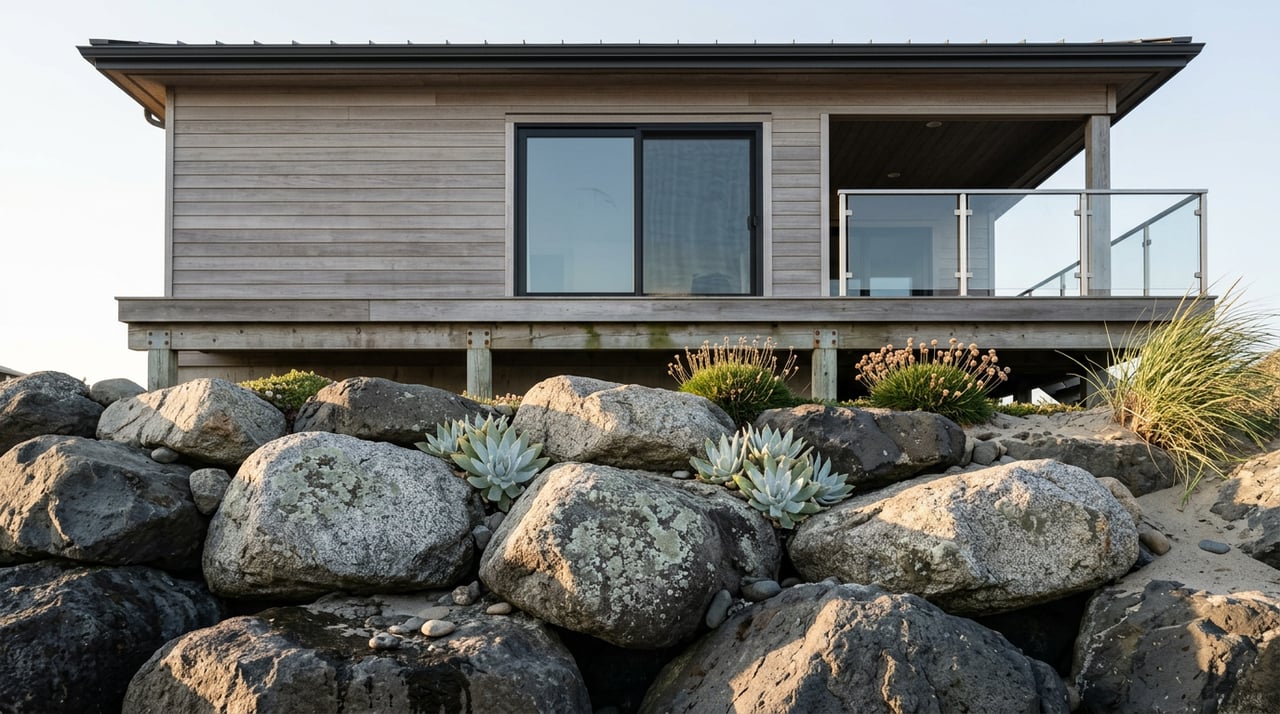
The engineer's report describes a roughly 6,000-foot rock revetment built from about 110,000 tons of riprap along the ocean side of the development, placed originally during emergency storm response in the early 2000s. The recently completed repair project restored and reinforced approximately 1,900 linear feet of that revetment, with fieldwork carried out over roughly three months in late 2025. The geotechnical and design work came from Haley & Aldrich, construction from Kies & Son Construction, engineering review from MNS Engineers, and environmental compliance and biological monitoring from BKF Engineers, whose scope included pre-construction surveys and restoration planting to protect sensitive coastal habitat during the work.
The project was significant enough that Haley & Aldrich's team won a 2026 Public Works Project of the Year award from the American Public Works Association, in the under-$5 million disaster and emergency construction repair category, for the seawall restoration.
The district's own draft budget for the fiscal year ending June 30, 2026 shows property assessment revenue of roughly $227,664 for Zone 1, split between member assessments and a smaller contribution from the Pajaro Dunes Association for stairway access, plus interest income bringing total revenue to about $247,664. That is the ordinary annual operating number, separate from the larger sum financed through the loan secured by the 2024/2025 special assessment to fund the repair itself. In other words, the row-based formula isn't background trivia. It is actively distributing the cost of a project that just got built, got inspected, and got recognized industry-wide.
What It Means When You're Comparing Coastal Complexes
Most coastal HOAs bundle armoring, erosion control, or shoreline maintenance into one per-unit due, if they address it at all. Pajaro Dunes formalized something different: a legally distinct hazard abatement district that assigns cost by exposure, not by unit type or purchase price. That has a real consequence for anyone comparing a Pajaro Dunes listing against another coastal property using HOA dues alone as the yardstick.
A front-row house with a lower quoted HOA fee than a comparable inland property can still carry a meaningfully higher total cost of ownership once its GHAD share is added in, precisely because it sits closest to the hazard the district exists to manage. A back-row house in the same complex, priced only slightly lower, may carry a fraction of that exposure. The view premium you pay once at closing and the protection premium you pay every year afterward are not the same number, and they don't move together.
Where to Actually Look Before You Write an Offer
Ask for two sets of financial documents, not one. The HOA's dues schedule and reserve study tell you about roofs, landscaping, and the gatehouse. The GHAD's engineer's report and recent board meeting packets tell you about the revetment, the river wall, and your row's share of both. The district's project budget and cost allocation page lets a buyer look up the annual assessment tied to a specific lot for the current property tax year, which is worth doing before an offer goes in, not after escrow opens.
If you're looking at a Pelican Point unit, confirm all three charges separately: the quarterly association due, the additional PDA due, and the standalone river wall assessment on the tax bill. They are not the same line item, and a seller's disclosure that only lists the HOA due is telling you less than half the story.
This is the kind of detail that separates a listing sheet from an actual understanding of what you're buying into. It's also exactly the kind of due diligence Melanie & Natalia walks Pajaro Dunes buyers through before they ever write an offer, because knowing which row you're in matters as much as knowing which building you're in. If you're comparing properties in Pajaro Dunes and want a clear read on what a specific lot's coastal assessment actually looks like, schedule a consultation and bring the address.